
General Mills Boo Berry vs. Mozzarella cheese sticks — In-Depth Nutrition Comparison
Compare
The main differences between general Mills Boo Berry and mozzarella cheese sticks
- Mozzarella cheese sticks contain less iron, vitamin B12, vitamin B6, vitamin B3, zinc, vitamin B2, vitamin B1, folate, and vitamin A than general Mills Boo Berry.
- Daily need coverage for iron for general Mills Boo Berry is 160% higher.
- Mozzarella cheese sticks have 18 times less vitamin B6 than general Mills Boo Berry. General Mills Boo Berry has 1.51mg of vitamin B6, while mozzarella cheese sticks have 0.084mg.
- General Mills Boo Berry is lower in saturated fat.
Food types used in this article are Cereals ready-to-eat, GENERAL MILLS, BOO BERRY and DENNY'S, mozzarella cheese sticks.
Infographic
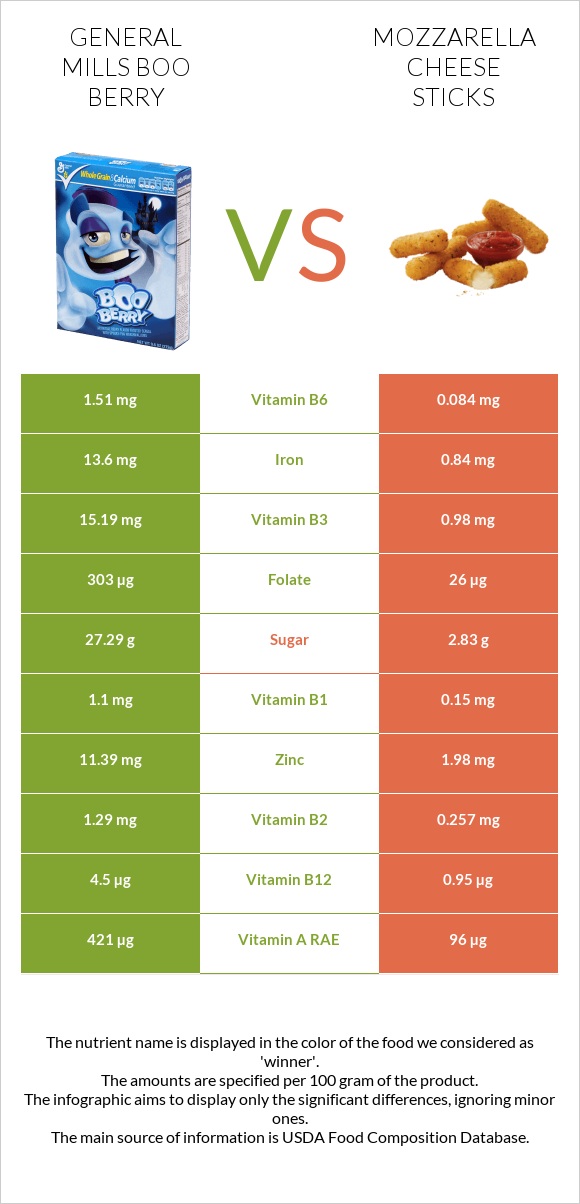
Infographic link
Mineral Comparison
The mineral comparison score is based on which food has a more favorable amount of each mineral. The �coverage� charts below show how much of the daily mineral needs are covered by the selected amount of each food.
| Contains more MagnesiumMagnesium | +128.6% |
| Contains more PotassiumPotassium | +34.7% |
| Contains more IronIron | +1519% |
| Contains more CopperCopper | +92.5% |
| Contains more ZincZinc | +475.3% |
| Contains less SodiumSodium | -54.6% |
| Contains more PhosphorusPhosphorus | +96.7% |
| Contains more ManganeseManganese | +∞% |
| Contains more SeleniumSelenium | +149.2% |
Vitamin Comparison
The vitamin comparison score is based on the number of vitamins in which one food is richer than the other. The �coverage� charts below show how much of the daily vitamin needs are covered by the selected amount of each food.
| Contains more Vitamin CVitamin C | +∞% |
| Contains more Vitamin DVitamin D | +∞% |
| Contains more Vitamin AVitamin A | +338.5% |
| Contains more Vitamin B1Vitamin B1 | +633.3% |
| Contains more Vitamin B2Vitamin B2 | +401.9% |
| Contains more Vitamin B3Vitamin B3 | +1450% |
| Contains more Vitamin B6Vitamin B6 | +1697.6% |
| Contains more Vitamin B12Vitamin B12 | +373.7% |
| Contains more FolateFolate | +1065.4% |
| Contains more Vitamin EVitamin E | +27.6% |
| Contains more Vitamin B5Vitamin B5 | +∞% |
| Contains more Vitamin KVitamin K | +1487.5% |
All nutrients comparison - raw data values
| Nutrient |  |
 |
DV% diff. |
| Iron | 13.6mg | 0.84mg | 160% |
| Vitamin B12 | 4.5µg | 0.95µg | 148% |
| Vitamin B6 | 1.51mg | 0.084mg | 110% |
| Vitamin B3 | 15.19mg | 0.98mg | 89% |
| Zinc | 11.39mg | 1.98mg | 86% |
| Vitamin B1 | 1.1mg | 0.15mg | 79% |
| Vitamin B2 | 1.29mg | 0.257mg | 79% |
| Folate | 303µg | 26µg | 69% |
| Vitamin A | 421µg | 96µg | 36% |
| Omega-3 (ALA) | 0.524g | 33% | |
| Saturated fat | 0.5g | 6.643g | 28% |
| Phosphorus | 182mg | 358mg | 25% |
| Polyunsaturated fat | 1.39g | 5.104g | 25% |
| Omega-6 (Linoleic acid) | 4.306g | 25% | |
| Sodium | 458mg | 1008mg | 24% |
| Fats | 4.3g | 17.87g | 21% |
| Vitamin C | 18.2mg | 20% | |
| Vitamin K | 1.6µg | 25.4µg | 20% |
| Carbs | 85.4g | 27.22g | 19% |
| Selenium | 6.5µg | 16.2µg | 18% |
| Protein | 5.5g | 13.56g | 16% |
| Manganese | 0.363mg | 16% | |
| Vitamin D* | 121 IU | 15% | |
| Vitamin D | 3µg | 15% | |
| Cholesterol | 0mg | 32mg | 11% |
| Fiber | 4.2g | 1.6g | 10% |
| Starch | 21.67g | 9% | |
| Vitamin B5 | 0.38mg | 8% | |
| Copper | 0.129mg | 0.067mg | 7% |
| Magnesium | 48mg | 21mg | 6% |
| Monounsaturated fat | 2.09g | 4.287g | 5% |
| Calories | 386kcal | 324kcal | 3% |
| Calcium | 303mg | 331mg | 3% |
| Choline | 10.9mg | 2% | |
| Potassium | 163mg | 121mg | 1% |
| Vitamin E | 0.58mg | 0.74mg | 1% |
| Protein per 100 calories | 1.4g | 4.2g | N/A |
| Calories per 10 g protein | 702kcal | 239kcal | N/A |
| Weight per 100 calories | 26g | 31g | N/A |
| Unsaturated / Saturated Fat ratio | 7 | 1.4 | N/A |
| Net carbs | 81.2g | 25.62g | N/A |
| Sugar | 27.29g | 2.83g | N/A |
| Trans fat | 0g | 0.372g | N/A |
| Tryptophan | 0.175mg | 0% | |
| Threonine | 0.472mg | 0% | |
| Isoleucine | 0.718mg | 0% | |
| Leucine | 1.468mg | 0% | |
| Lysine | 1.211mg | 0% | |
| Methionine | 0.411mg | 0% | |
| Phenylalanine | 0.811mg | 0% | |
| Valine | 0.934mg | 0% | |
| Histidine | 0.441mg | 0% | |
| Fructose | 0.2g | 0% | |
| Omega-3 (EPA) | 0g | 0.003g | N/A |
| Omega-3 (DPA) | 0g | 0.006g | N/A |
| Omega-3 (Eicosatrienoic acid) | 0.001g | N/A | |
| Omega-6 (Gamma-linolenic acid) | 0.045g | N/A | |
| Omega-6 (Dihomo-gamma-linolenic acid) | 0.011g | N/A | |
| Omega-6 (Eicosadienoic acid) | 0.006g | N/A |
Macronutrient Comparison
Macronutrient breakdown side-by-side comparison
Protein:
5.5 g
Fats:
4.3 g
Carbs:
85.4 g
Water:
1.89 g
Other:
2.91 g
Protein:
13.56 g
Fats:
17.87 g
Carbs:
27.22 g
Water:
37.63 g
Other:
3.72 g
| Contains more CarbsCarbs | +213.7% |
| Contains more ProteinProtein | +146.5% |
| Contains more FatsFats | +315.6% |
| Contains more WaterWater | +1891% |
Fat Type Comparison
Fat type breakdown side-by-side comparison
Saturated fat:
Sat. Fat
0.5 g
Monounsaturated fat:
Mono. Fat
2.09 g
Polyunsaturated fat:
Poly. Fat
1.39 g
Saturated fat:
Sat. Fat
6.643 g
Monounsaturated fat:
Mono. Fat
4.287 g
Polyunsaturated fat:
Poly. Fat
5.104 g
| Contains less Sat. FatSaturated fat | -92.5% |
| Contains more Mono. FatMonounsaturated fat | +105.1% |
| Contains more Poly. FatPolyunsaturated fat | +267.2% |


