Foodstruct Nutrition Search | Diet Analysis | Food Comparison | Glycemic Index Chart | Insulin Index Chart | Blog | Subscribe | Sign Up

Goat cheese vs. Feta — Health Impact and Nutrition Comparison

Article author photo Jack  Yacoubian by Jack Yacoubian | Last updated on April 06, 2023
Medically reviewed by Astghik Grigoryan Article author photo Astghik Grigoryan
Goat cheese
vs
Feta

Summary

Feta is rich in calcium, zinc, B2, B5, B6, B12, folate. It is lower in calories and fats. Feta has a higher amount of sodium. Goat cheese is rich in phosphorus, copper, magnesium, iron, vitamin A, and proteins. It has a lower glycemic index and carbohydrate content.

Introduction

Feta is a white cheese that originates from Greece. Feta cheesemaking uses sheep's milk. It is used as a "refreshing type of cheese," meaning it is not melted and not used for baking or cooking. Feta cheese usage in salads is widespread, and it is associated with olive oil and lemon dressing. It is also used in dips and as a condiment in sandwiches or pizzas. It is considered a cultural food for Greeks and is common in Greek gastronomy. Feta cheesemaking dates back to the 8th century BC.

On the other hand, we have goat cheese to compare with feta. As the name suggests, goat cheese comes from goat milk, and it can be soft, semisolid, and hard. Goat cheese can sometimes have a tart flavor due to the nutrients and compounds present in goat's milk. Goat cheese is most prevalent in France, as it is part of the French gastronomy and is famously known as "Fromage de chèvre." It is usually considered a delicacy and can be consumed raw, baked in a pie, added as a topping on pizza, or baked separately. It is used as a spread on bread and pairs it with something sweet such as honey.

This article will discuss the difference between feta cheese and goat cheese according to the nutritional content, vitamin content, mineral content, health impacts, and variations and usages.

Nutritional content comparison

The nutritional content comparison will be covering the amounts of carbohydrates, glycemic index, calories, proteins, fats, including saturated, monounsaturated, polyunsaturated, and cholesterol of both feta and goat cheese, based on 100g.

Carbohydrates

Feta and goat cheese have low amounts of carbohydrates. Feta has 4.1g of carbohydrates, whereas goat cheese has negligible amounts of carbohydrates which is 0.1g.

Glycemic index

The glycemic index of feta is 27, which is considered low. However, for goat cheese, due to the lack of carbohydrates, the glycemic index is negligible.

Calories

Feta has 264 calories, which is lower than the calories in goat cheese, 364 calories per 100g.

Protein

The protein content of feta is 14.21g compared to goat cheese which is 21.58g. Goat cheese has higher amounts of protein relative to feta.

Fat

Feta contains 21.28g of fat, whereas goat cheese contains 29.8g of fat, which means feta has lower fat.

The distribution of fat content for both kinds of cheese is in the following way:

Saturated fat

Feta contains 14.9g of saturated fat in comparison to goat cheese which has 20.6g. Thus, feta contains lower amounts of saturated fat compared to goat cheese.

Monounsaturated fat and polyunsaturated fat

Both contain similar amounts of monounsaturated fats, for feta 4.6g and goat cheese 6.8g.

The polyunsaturated fat is similar, with 0.6g for feta and 0.7g for goat cheese.

We can say that goat cheese is richer in unsaturated fats.

Cholesterol

The cholesterol content present in feta is 89mg compared to goat cheese which contains 79mg. The daily recommendation of cholesterol is about 300mg.

Vitamin content comparison

The vitamin profiles of both feta and goat cheese, taking into consideration the recommended daily value (%RDV), is as follows:

 FetaGoat cheese
Vitamin A422IU 14% RDV1464IU 45% RDV
Vitamin B20.84mg 65% RDV0.67mg 50% RDV
Vitamin B121.65mg 70%RDV0.22mg 10%RDV
Vitamin B60.42mg 25% RDV0.1mg 4% RDV
Vitamin B50.97mg 20% RDV0.2mg 4%RDV
Folate32mcg 8% RDV2mg 1% RDV

As the data shows, feta has a richer vitamin profile compared to goat cheese. Feta is richer in Vitamin B2, B12, B6, B5, folate. However, goat cheese is richer only in vitamin A compared to one feta.

Vitamin Comparison

Vitamin comparison score is based on the number of vitamins by which one or the other food is richer. The "coverage" charts below show how much of the daily needs can be covered by 300 grams of the food.
Vitamin C Vit. C Vitamin D Vit. D Vitamin A Vit. A Vitamin E Vit. E Vitamin B1 Vit. B1 Vitamin B2 Vit. B2 Vitamin B3 Vit. B3 Vitamin B5 Vit. B5 Vitamin B6 Vit. B6 Vitamin B12 Vit. B12 Vitamin K Vit. K Folate Folate 0% 7.5% 136% 5.2% 18% 156% 22% 11% 14% 28% 6.3% 1.5%
Feta
6
Vitamin C Vit. C Vitamin D Vit. D Vitamin A Vit. A Vitamin E Vit. E Vitamin B1 Vit. B1 Vitamin B2 Vit. B2 Vitamin B3 Vit. B3 Vitamin B5 Vit. B5 Vitamin B6 Vit. B6 Vitamin B12 Vit. B12 Vitamin K Vit. K Folate Folate 0% 6% 42% 3.6% 39% 195% 19% 58% 98% 211% 4.5% 24%
Contains more Vitamin DVitamin D +25%
Contains more Vitamin AVitamin A +225.6%
Contains more Vitamin EVitamin E +44.4%
Contains more Vitamin B3Vitamin B3 +15.8%
Contains more Vitamin KVitamin K +38.9%
Contains more Vitamin B1Vitamin B1 +113.9%
Contains more Vitamin B2Vitamin B2 +24.9%
Contains more Vitamin B5Vitamin B5 +408.9%
Contains more Vitamin B6Vitamin B6 +606.7%
Contains more Vitamin B12Vitamin B12 +668.2%
Contains more FolateFolate +1500%
~equal in Vitamin C ~0mg

Mineral content comparison

 FetaGoat cheese
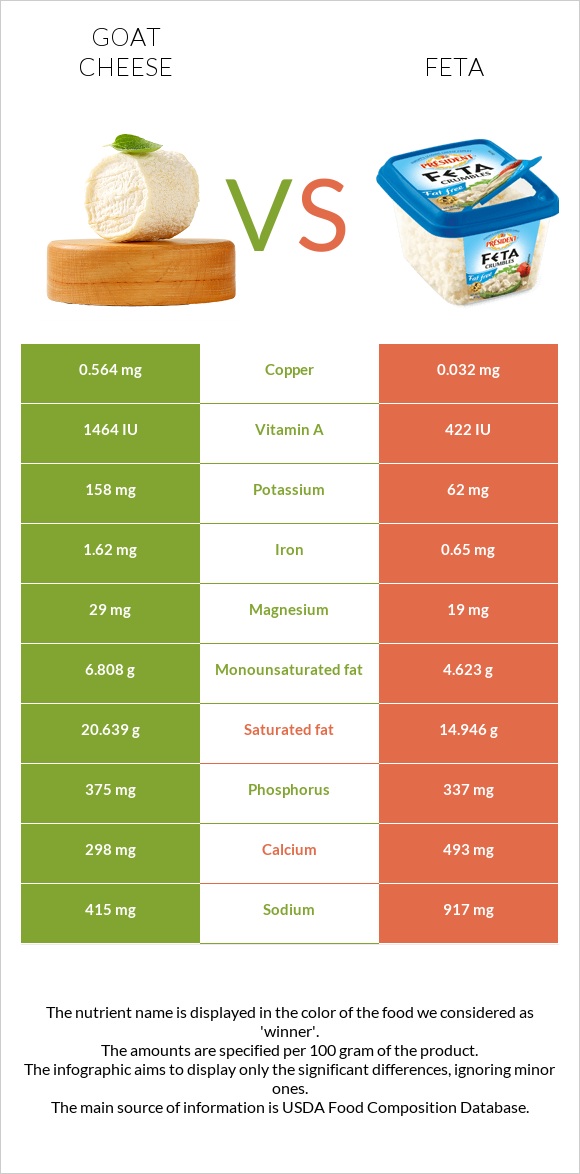
Calcium493 mg 38% RDV298 mg 23% RDV
Sodium917 mg 38% RDV415 mg 17% RDV
Phosphorus337 mg 27% RDV375 mg 30% RDV
Copper0.032 mg 4% RDV0.564 mg 63% RDV
Magnesium19 mg 5% RDV29 mg 7% RDV
Zinc2.88 mg 26% RDV0.66 mg 6% RDV
Iron0.65 4% RDV1.62 mg 9% RDV

As the data shows, feta is richer in calcium and zinc. However, goat cheese is richer in phosphorus, copper, magnesium, and iron. It is important to note that feta has higher amounts of sodium.

Mineral Comparison

Mineral comparison score is based on the number of minerals by which one or the other food is richer. The "coverage" charts below show how much of the daily needs can be covered by 300 grams of the food.
Magnesium Magnesium Calcium Calcium Potassium Potassium Iron Iron Copper Copper Zinc Zinc Phosphorus Phosphorus Sodium Sodium Manganese Manganese Selenium Selenium 21% 89% 14% 61% 188% 18% 161% 54% 12% 21%
Feta
3
Magnesium Magnesium Calcium Calcium Potassium Potassium Iron Iron Copper Copper Zinc Zinc Phosphorus Phosphorus Sodium Sodium Manganese Manganese Selenium Selenium 14% 148% 5.5% 24% 11% 79% 144% 120% 3.7% 82%
Contains more MagnesiumMagnesium +52.6%
Contains more PotassiumPotassium +154.8%
Contains more IronIron +149.2%
Contains more CopperCopper +1662.5%
Contains more PhosphorusPhosphorus +11.3%
Contains less SodiumSodium -54.7%
Contains more ManganeseManganese +232.1%
Contains more CalciumCalcium +65.4%
Contains more ZincZinc +336.4%
Contains more SeleniumSelenium +294.7%

Weight Loss & Diets

We can consume feta and goat cheese during keto, dash, Atkins, Mediterranean, paleo, vegetarian, pescatarian, intermittent fasting, low carb, and anti-inflammatory diets.

For the Dukan diet, Individuals who are undergoing the Dukan diet can consume feta cheese. However, people who follow the Dukan diet must avoid goat cheese.

Vegans must avoid feta and goat cheese during the vegan diet.

Health impacts

Health Benefits

Cardiovascular Health

Section reviewed by cardiologist Astghik Grigoryan Article author photo Astghik Grigoryan

Consumption of a moderate amount of dairy cheese, including feta and goat cheese, has reduced the risks of cardiovascular diseases. (1)

The cholesterol content of goat cheese is higher than that of feta cheese. However, there are a lot of types of feta cheese with different amounts of cholesterol (2). This study demonstrated the possibility of producing cholesterol-reduced Feta cheese with little difference in physicochemical and sensory properties compared with regular Feta cheese (3).

It should be noted that people taking MAO inhibitors (particularly antidepressants) may experience a hypertensive crisis when eating cheeses, including feta and goat cheese, which contain tyramine (4).

Diabetes

Goat cheese has shown a decrease in appetite and hunger after consumption compared to other types of dairy, including feta. This decrease in hunger and appetite would result in a decreased food intake in individuals who have diabetes, which results in lower blood glucose levels. (5)

Cancer

Consumption of dairy, including feta and goat cheese, has shown a reduction in risks of the development of lung cancer. (6)

Emphysema

Both feta and goat cheese contains high amounts of methionine. This amino acid protects against low to moderate degrees of emphysema due to smoking. (7)

Downsides & Risks

Diabetes

Diabetic people should avoid eating feta cheese, and this is due to the high amounts of sodium that would affect kidney filtration of excess glucose. (8)

Cancer

During dairy consumption, in specific feta cheese and goat cheese, an increase in rates for prostate cancer in males and uterine and breast cancer in females is recorded. (9)

In addition, Cancer patients undergoing treatment should avoid feta and goat cheese from unpasteurized milk during their treatments due to the risk of gastrointestinal infections that might occur due to unpasteurized milk. However, there should be no concern if feta and goat cheese are from pasteurized milk. (10)

Allergy and intolerance

Feta has a higher lactose content compared to goat cheese; Lactose intolerant individuals should avoid it.

Goat cheese allergies are also common. However, this is due to goat cheese casein and not lactose.

Both feta and goat cheese have shown allergic and intolerance responses, feta due to lactose intolerance, and goat cheese due to goat casein. (11)

Article author photo Jack  Yacoubian
Education: Haigazian Medical University
Last updated: April 06, 2023
Medically reviewed by Astghik Grigoryan

Infographic

Goat cheese vs Feta infographic
Infographic link

All nutrients comparison - raw data values

Nutrient Goat cheese Feta DV% diff.
Vitamin B12 0.22µg 1.69µg 61%
Copper 0.564mg 0.032mg 59%
Vitamin A 407µg 125µg 31%
Vitamin B6 0.06mg 0.424mg 28%
Saturated fat 20.639g 14.946g 26%
Sodium 415mg 917mg 22%
Calcium 298mg 493mg 20%
Zinc 0.66mg 2.88mg 20%
Selenium 3.8µg 15µg 20%
Vitamin B5 0.19mg 0.967mg 16%
Protein 21.58g 14.21g 15%
Fats 29.84g 21.28g 13%
Vitamin B2 0.676mg 0.844mg 13%
Iron 1.62mg 0.65mg 12%
Folate 2µg 32µg 8%
Vitamin B1 0.072mg 0.154mg 7%
Calories 364kcal 264kcal 5%
Phosphorus 375mg 337mg 5%
Monounsaturated fat 6.808g 4.623g 5%
Cholesterol 79mg 89mg 3%
Potassium 158mg 62mg 3%
Manganese 0.093mg 0.028mg 3%
Magnesium 29mg 19mg 2%
Carbs 0.12g 4.09g 1%
Vitamin D* 22 IU 16 IU 1%
Vitamin D 0.5µg 0.4µg 1%
Vitamin E 0.26mg 0.18mg 1%
Vitamin B3 1.148mg 0.991mg 1%
Vitamin K 2.5µg 1.8µg 1%
Polyunsaturated fat 0.709g 0.591g 1%
Protein per 100 calories 5.9g 5.4g N/A
Calories per 10 g protein 169kcal 186kcal N/A
Weight per 100 calories 27g 38g N/A
Unsaturated / Saturated Fat ratio 0.36 0.35 N/A
Net carbs 0.12g 4.09g N/A
Sugar 0.12g 4.09g N/A
Choline 15.4mg 15.4mg 0%
Tryptophan 0.227mg 0.2mg 0%
Threonine 0.805mg 0.637mg 0%
Isoleucine 0.893mg 0.803mg 0%
Leucine 1.861mg 1.395mg 0%
Lysine 1.549mg 1.219mg 0%
Methionine 0.575mg 0.368mg 0%
Phenylalanine 0.859mg 0.675mg 0%
Valine 1.485mg 1.065mg 0%
Histidine 0.589mg 0.397mg 0%

Macronutrient Comparison

Macronutrient breakdown side-by-side comparison
22% 30% 46% 3%
Protein: 21.58 g
Fats: 29.84 g
Carbs: 0.12 g
Water: 45.52 g
Other: 2.94 g
Feta
3
14% 21% 4% 55% 5%
Protein: 14.21 g
Fats: 21.28 g
Carbs: 4.09 g
Water: 55.22 g
Other: 5.2 g
Contains more ProteinProtein +51.9%
Contains more FatsFats +40.2%
Contains more CarbsCarbs +3308.3%
Contains more WaterWater +21.3%
Contains more OtherOther +76.9%

Fat Type Comparison

Fat type breakdown side-by-side comparison
73% 24% 3%
Saturated fat: Sat. Fat 20.639 g
Monounsaturated fat: Mono. Fat 6.808 g
Polyunsaturated fat: Poly. Fat 0.709 g
Feta
1
74% 23% 3%
Saturated fat: Sat. Fat 14.946 g
Monounsaturated fat: Mono. Fat 4.623 g
Polyunsaturated fat: Poly. Fat 0.591 g
Contains more Mono. FatMonounsaturated fat +47.3%
Contains more Poly. FatPolyunsaturated fat +20%
Contains less Sat. FatSaturated fat -27.6%

People also compare

References

All the values for which the sources are not specified explicitly are taken from FDA’s Food Central. The exact link to the food presented on this page can be found below.

  1. Goat cheese - https://fdc.nal.usda.gov/fdc-app.html#/food-details/173433/nutrients
  2. Feta - https://fdc.nal.usda.gov/fdc-app.html#/food-details/173420/nutrients

All the Daily Values are presented for males aged 31-50, for 2000-calorie diets.

Data provided by FoodStruct.com should be considered and used as information only. Please consult your physician before beginning any diet.