
Restaurant, Chinese, chicken and vegetables vs. Frog legs — In-Depth Nutrition Comparison
Compare
What are the main differences between restaurant, Chinese, chicken and vegetables and frog legs?
- Restaurant, Chinese, chicken, and vegetables is richer in vitamin K, yet frog legs are richer in copper, protein, vitamin B12, iron, selenium, phosphorus, and vitamin B2.
- Restaurant, Chinese, chicken, and vegetables's daily need coverage for vitamin K is 45% higher.
- Restaurant, Chinese, chicken, and vegetables has 7 times more sodium than frog legs. Restaurant, Chinese, chicken, and vegetables has 413mg of sodium, while frog legs have 58mg.
We used Restaurant, Chinese, chicken, and vegetables and Frog legs, raw types in this comparison.
Infographic
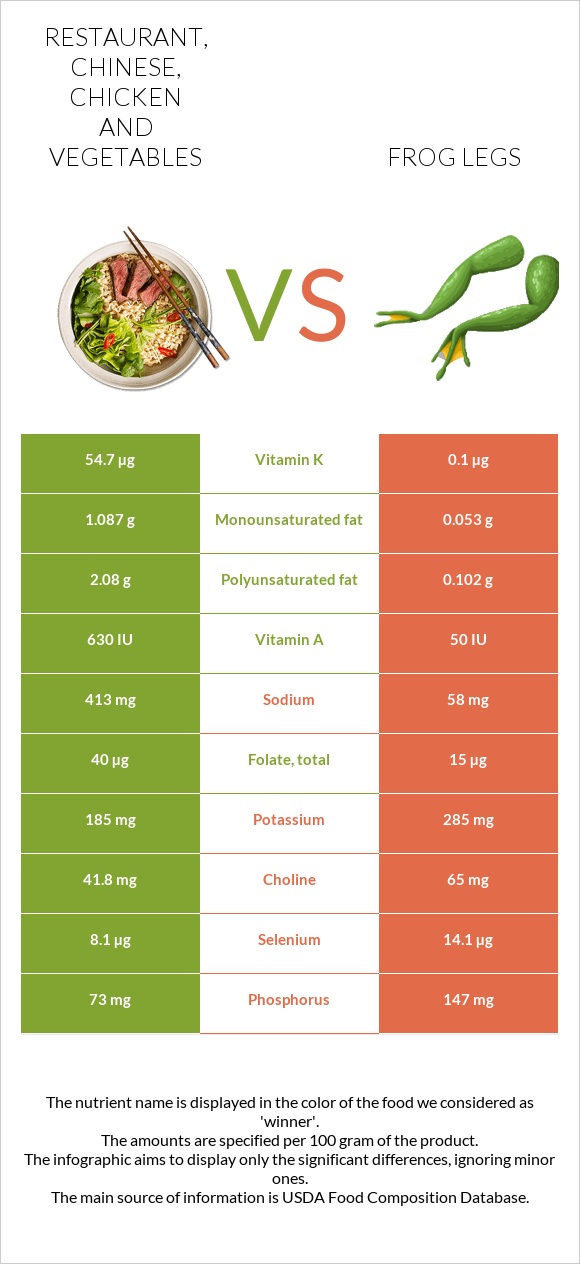
Infographic link
Mineral Comparison
The mineral comparison score is based on which food has a more favorable amount of each mineral. The �coverage� charts below show how much of the daily mineral needs are covered by the selected amount of each food.
| Contains more ManganeseManganese | +∞% |
| Contains more MagnesiumMagnesium | +33.3% |
| Contains more PotassiumPotassium | +54.1% |
| Contains more IronIron | +167.9% |
| Contains more CopperCopper | +468.2% |
| Contains more ZincZinc | +132.6% |
| Contains more PhosphorusPhosphorus | +101.4% |
| Contains less SodiumSodium | -86% |
| Contains more SeleniumSelenium | +74.1% |
Vitamin Comparison
The vitamin comparison score is based on the number of vitamins in which one food is richer than the other. The �coverage� charts below show how much of the daily vitamin needs are covered by the selected amount of each food.
| Contains more Vitamin CVitamin C | +∞% |
| Contains more Vitamin AVitamin A | +273.3% |
| Contains more Vitamin B3Vitamin B3 | +40.8% |
| Contains more Vitamin B5Vitamin B5 | +∞% |
| Contains more Vitamin B6Vitamin B6 | +93.3% |
| Contains more Vitamin KVitamin K | +54600% |
| Contains more FolateFolate | +166.7% |
| Contains more Vitamin DVitamin D | +∞% |
| Contains more Vitamin EVitamin E | +29.9% |
| Contains more Vitamin B1Vitamin B1 | +366.7% |
| Contains more Vitamin B2Vitamin B2 | +108.3% |
| Contains more Vitamin B12Vitamin B12 | +471.4% |
All nutrients comparison - raw data values
| Nutrient |  |
 |
DV% diff. |
| Vitamin K | 54.7µg | 0.1µg | 46% |
| Copper | 0.044mg | 0.25mg | 23% |
| Protein | 8.18g | 16.4g | 16% |
| Omega-3 (ALA) | 0.257g | 16% | |
| Sodium | 413mg | 58mg | 15% |
| Vitamin B12 | 0.07µg | 0.4µg | 14% |
| Polyunsaturated fat | 2.08g | 0.102g | 13% |
| Iron | 0.56mg | 1.5mg | 12% |
| Phosphorus | 73mg | 147mg | 11% |
| Selenium | 8.1µg | 14.1µg | 11% |
| Cholesterol | 21mg | 50mg | 10% |
| Vitamin B2 | 0.12mg | 0.25mg | 10% |
| Omega-6 (Linoleic acid) | 1.769g | 10% | |
| Vitamin C | 8.1mg | 0mg | 9% |
| Vitamin B1 | 0.03mg | 0.14mg | 9% |
| Vitamin B5 | 0.44mg | 9% | |
| Vitamin B6 | 0.232mg | 0.12mg | 9% |
| Fats | 4.56g | 0.3g | 7% |
| Folate | 40µg | 15µg | 6% |
| Zinc | 0.43mg | 1mg | 5% |
| Vitamin A | 56µg | 15µg | 5% |
| Manganese | 0.126mg | 5% | |
| Fiber | 0.9g | 0g | 4% |
| Choline | 41.8mg | 65mg | 4% |
| Potassium | 185mg | 285mg | 3% |
| Vitamin B3 | 1.69mg | 1.2mg | 3% |
| Saturated fat | 0.77g | 0.076g | 3% |
| Monounsaturated fat | 1.087g | 0.053g | 3% |
| Carbs | 5.38g | 0g | 2% |
| Vitamin E | 0.77mg | 1mg | 2% |
| Calories | 95kcal | 73kcal | 1% |
| Vitamin D* | 0 IU | 8 IU | 1% |
| Vitamin D | 0µg | 0.2µg | 1% |
| Magnesium | 15mg | 20mg | 1% |
| Starch | 1.63g | 1% | |
| Fructose | 0.5g | 1% | |
| Protein per 100 calories | 8.6g | 22g | N/A |
| Calories per 10 g protein | 116kcal | 45kcal | N/A |
| Weight per 100 calories | 105g | 137g | N/A |
| Unsaturated / Saturated Fat ratio | 4.1 | 2 | N/A |
| Net carbs | 4.48g | 0g | N/A |
| Calcium | 20mg | 18mg | 0% |
| Sugar | 2.93g | 0g | N/A |
| Trans fat | 0.014g | N/A | |
| Tryptophan | 0.074mg | 0% | |
| Threonine | 0.306mg | 0% | |
| Isoleucine | 0.306mg | 0% | |
| Leucine | 0.517mg | 0% | |
| Lysine | 0.454mg | 0% | |
| Methionine | 0.163mg | 0% | |
| Phenylalanine | 0.264mg | 0% | |
| Valine | 0.322mg | 0% | |
| Histidine | 0.179mg | 0% | |
| Omega-3 (EPA) | 0g | 0.014g | N/A |
| Omega-3 (DHA) | 0.001g | 0.02g | N/A |
| Omega-3 (DPA) | 0.002g | 0.007g | N/A |
| Omega-6 (Gamma-linolenic acid) | 0.005g | N/A | |
| Omega-6 (Dihomo-gamma-linolenic acid) | 0.004g | N/A | |
| Omega-6 (Eicosadienoic acid) | 0.003g | N/A |
Macronutrient Comparison
Macronutrient breakdown side-by-side comparison
Protein:
8.18 g
Fats:
4.56 g
Carbs:
5.38 g
Water:
80.24 g
Other:
1.64 g
Protein:
16.4 g
Fats:
0.3 g
Carbs:
0 g
Water:
81.9 g
Other:
1.4 g
| Contains more FatsFats | +1420% |
| Contains more CarbsCarbs | +∞% |
| Contains more ProteinProtein | +100.5% |
~equal in
Water
~81.9g
Fat Type Comparison
Fat type breakdown side-by-side comparison
Saturated fat:
Sat. Fat
0.77 g
Monounsaturated fat:
Mono. Fat
1.087 g
Polyunsaturated fat:
Poly. Fat
2.08 g
Saturated fat:
Sat. Fat
0.076 g
Monounsaturated fat:
Mono. Fat
0.053 g
Polyunsaturated fat:
Poly. Fat
0.102 g
| Contains more Mono. FatMonounsaturated fat | +1950.9% |
| Contains more Poly. FatPolyunsaturated fat | +1939.2% |
| Contains less Sat. FatSaturated fat | -90.1% |