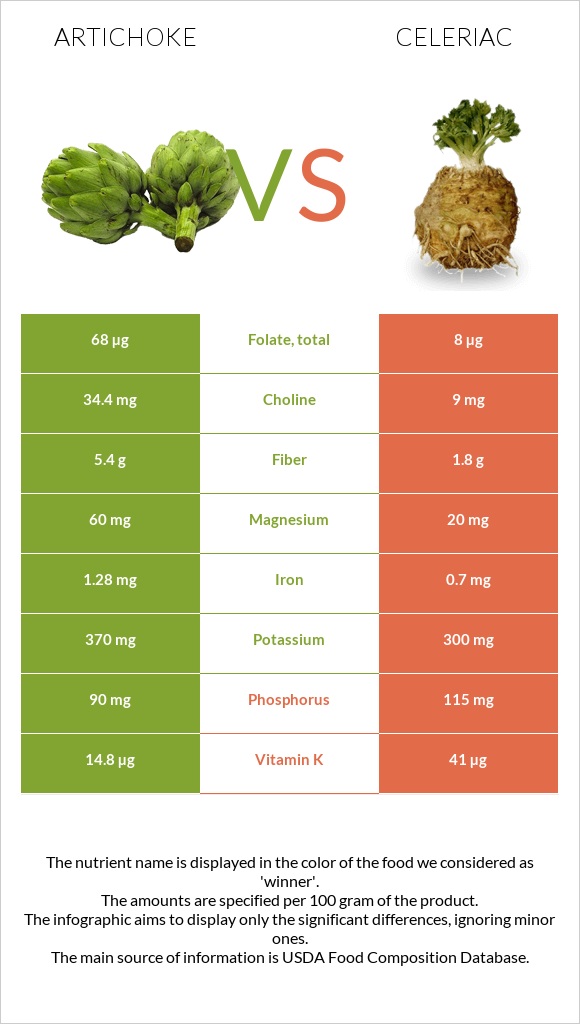
How are artichoke and celeriac different? Artichoke is richer in copper, folate, fiber, magnesium, and iron, while celeriac is higher in vitamin K. Celeriac covers your daily need for vitamin K 22% more than artichoke. Artichoke contains 9 times more folate than celeriac. Artichoke contains 68µg of folate, while celeriac contains 8µg. Artichokes, (globe or french), raw and Celeriac, raw types were used in this article.
Infographic
Mineral Comparison
The mineral comparison score is based on which food has a more favorable amount of each mineral. The �coverage� charts below show how much of the daily mineral needs are covered by the selected amount of each food.
6
100 g
300 g
1 artichoke, medium - 128g 1 artichoke, large - 162g
Magnesium
Magnesium
Calcium
Calcium
Potassium
Potassium
Iron
Iron
Copper
Copper
Zinc
Zinc
Phosphorus
Phosphorus
Sodium
Sodium
Manganese
Manganese
Selenium
Selenium
43%
13%
33%
48%
77%
13%
39%
12%
33%
1.1%
2
100 g
300 g
1 cup - 156g
Magnesium
Magnesium
Calcium
Calcium
Potassium
Potassium
Iron
Iron
Copper
Copper
Zinc
Zinc
Phosphorus
Phosphorus
Sodium
Sodium
Manganese
Manganese
Selenium
Selenium
14%
13%
26%
26%
23%
9%
49%
13%
21%
3.8%
Vitamin Comparison
The vitamin comparison score is based on the number of vitamins in which one food is richer than the other. The �coverage� charts below show how much of the daily vitamin needs are covered by the selected amount of each food.
5
100 g
300 g
1 artichoke, medium - 128g 1 artichoke, large - 162g
Vitamin C
Vit. C
Vitamin D
Vit. D
Vitamin A
Vit. A
Vitamin E
Vit. E
Vitamin B1
Vit. B1
Vitamin B2
Vit. B2
Vitamin B3
Vit. B3
Vitamin B5
Vit. B5
Vitamin B6
Vit. B6
Vitamin B12
Vit. B12
Vitamin K
Vit. K
Folate
Folate
39%
0%
0.33%
3.8%
18%
15%
20%
20%
27%
0%
37%
51%
3
100 g
300 g
1 cup - 156g
Vitamin C
Vit. C
Vitamin D
Vit. D
Vitamin A
Vit. A
Vitamin E
Vit. E
Vitamin B1
Vit. B1
Vitamin B2
Vit. B2
Vitamin B3
Vit. B3
Vitamin B5
Vit. B5
Vitamin B6
Vit. B6
Vitamin B12
Vit. B12
Vitamin K
Vit. K
Folate
Folate
27%
0%
0%
7.2%
13%
14%
13%
21%
38%
0%
103%
6%
All nutrients comparison - raw data values
Nutrient
DV% diff.
Vitamin K
14.8µg
41µg
22%
Copper
0.231mg
0.07mg
18%
Folate
68µg
8µg
15%
Fiber
5.4g
1.8g
14%
Magnesium
60mg
20mg
10%
Iron
1.28mg
0.7mg
7%
Choline
34.4mg
9mg
5%
Protein
3.27g
1.5g
4%
Vitamin C
11.7mg
8mg
4%
Phosphorus
90mg
115mg
4%
Manganese
0.256mg
0.158mg
4%
Vitamin B6
0.116mg
0.165mg
4%
Potassium
370mg
300mg
2%
Vitamin B1
0.072mg
0.05mg
2%
Vitamin B3
1.046mg
0.7mg
2%
Zinc
0.49mg
0.33mg
1%
Vitamin E
0.19mg
0.36mg
1%
Selenium
0.2µg
0.7µg
1%
Polyunsaturated fat
0.064g
0.148g
1%
Calories
47kcal
42kcal
0%
Protein per 100 calories
7g
3.6g
N/A
Calories per 10 g protein
144kcal
280kcal
N/A
Weight per 100 calories
213g
238g
N/A
Fats
0.15g
0.3g
0%
Net carbs
5.11g
7.4g
N/A
Carbs
10.51g
9.2g
0%
Calcium
44mg
43mg
0%
Sugar
0.99g
1.6g
N/A
Sodium
94mg
100mg
0%
Vitamin A
1µg
0µg
0%
Vitamin B2
0.066mg
0.06mg
0%
Vitamin B5
0.338mg
0.352mg
0%
Saturated fat
0.036g
0.079g
0%
Monounsaturated fat
0.005g
0.058g
0%
Macronutrient Comparison
Macronutrient breakdown side-by-side comparison
2
3%
11%
85%
Protein:
3.27 g
Fats:
0.15 g
Carbs:
10.51 g
Water:
84.94 g
Other:
1.13 g
2
9%
88%
Protein:
1.5 g
Fats:
0.3 g
Carbs:
9.2 g
Water:
88 g
Other:
1 g
Contains
more
Protein Protein
+118%
Contains
more
Carbs Carbs
+14.2%
Contains
more
Fats Fats
+100%
Fat Type Comparison
Fat type breakdown side-by-side comparison
1
34%
5%
61%
Saturated fat:
Sat. Fat
0.036 g
Monounsaturated fat:
Mono. Fat
0.005 g
Polyunsaturated fat:
Poly. Fat
0.064 g
2
28%
20%
52%
Saturated fat:
Sat. Fat
0.079 g
Monounsaturated fat:
Mono. Fat
0.058 g
Polyunsaturated fat:
Poly. Fat
0.148 g
Contains
less
Sat. Fat Saturated fat
-54.4%
Contains
more
Mono. Fat Monounsaturated fat
+1060%
Contains
more
Poly. Fat Polyunsaturated fat
+131.3%